How to Calculate a Tip
Learn how to calculate a tip quickly using a simple percentage formula. See how to calculate the tip amount, total bill, split the bill between multiple people, and handle common tip percentages such as 15%, 18%, 20%, and 25%.
Compound interest lets your money earn interest on both the original amount and the interest already accumulated. Learn how compound interest works, see the formula with simple examples, and understand how interest rates, compounding frequency, regular deposits, and time affect your savings.
 ToolCMB Team
9 min read
ToolCMB Team
9 min read
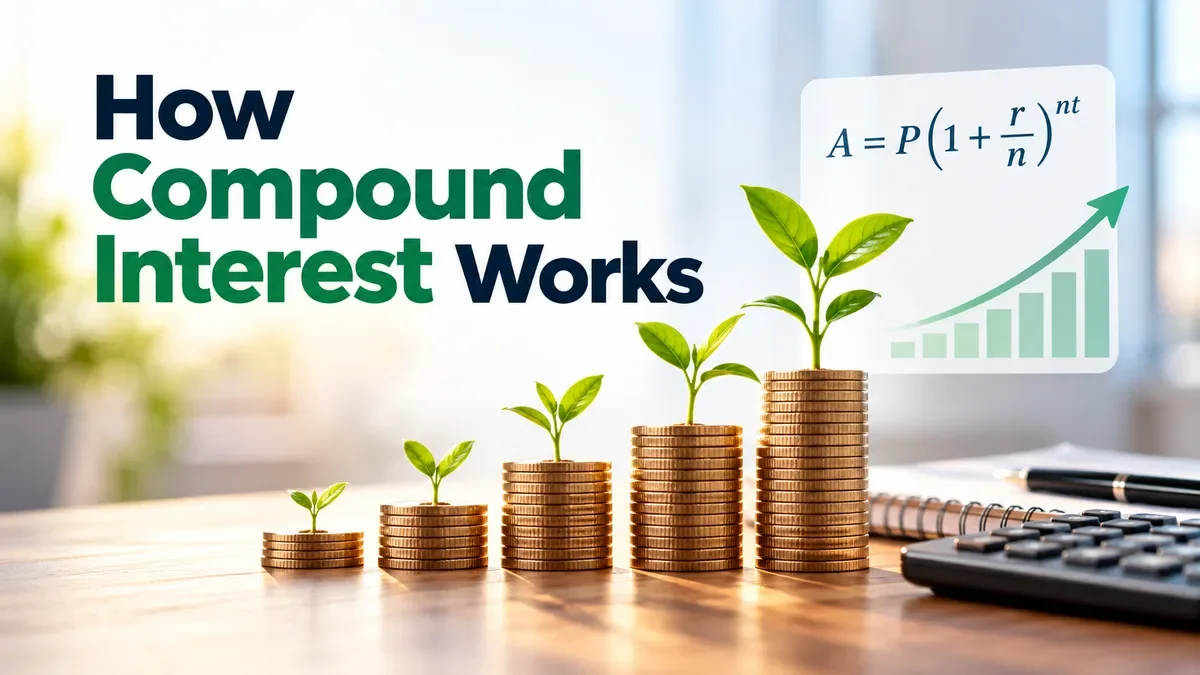
Compound interest is interest calculated on both your original principal and the interest that has already been added to the account.
With simple interest, interest is calculated only on the original principal. With compound interest, previously earned interest becomes part of the balance and can generate additional interest.
That creates a compounding effect.
For example, suppose you deposit $10,000 into an account earning 5% per year, with interest compounded annually.
After the first year, you earn $500 in interest, bringing the balance to $10,500.
During the second year, the 5% interest is calculated on $10,500 rather than the original $10,000. The second year's interest is therefore $525.
Over many years, this difference can become substantial.
For a quick comparison using different rates, periods, and deposit schedules, you can use the ToolCMB Interest Calculator.
The standard compound interest formula is:
A = P × (1 + r/n)^(nt)
Where:
A = final balance
P = initial principal
r = annual interest rate expressed as a decimal
n = number of compounding periods per year
t = number of years
For example, if you invest $10,000 at 5% annual interest for 10 years with annual compounding:
A = $10,000 × (1 + 0.05/1)^(1 × 10)
The resulting balance is approximately $16,289.
That means the investment earns about $6,289 in interest over the 10-year period.
The exact result changes when you change the interest rate, compounding frequency, time period, or add regular contributions.
The biggest difference is what happens to previously earned interest.
With simple interest, the interest calculation remains based on the original principal.
With compound interest, the balance grows and future interest is calculated using the larger balance.
Consider $10,000 earning 5% for 30 years:
| Period | Compound Interest | Simple Interest |
|---|---|---|
| 10 years | $16,289 | $15,000 |
| 20 years | $26,533 | $20,000 |
| 30 years | $43,219 | $25,000 |
| 40 years | $70,400 | $30,000 |
The longer the period, the larger the difference becomes.
This is one reason compound growth is often described as a snowball effect: the accumulated interest can itself begin generating additional interest.
One of the most important factors in compound growth is time.
A few additional years may not look significant when you are starting, but the additional compounding periods can have a much larger effect later.
For example, at 5% annual compounding:
$10,000 becomes about $16,289 after 10 years.
It becomes about $26,533 after 20 years.
It reaches about $43,219 after 30 years.
After 40 years, it reaches about $70,400.
The balance does not increase by the same dollar amount every year. As the balance becomes larger, the interest earned each year can also become larger.
This is why starting earlier can be valuable even when the initial amount is relatively small.
Interest may be compounded annually, semi-annually, quarterly, monthly, daily, or continuously.
The compounding frequency determines how often earned interest is added to the balance.
For example, with $10,000 earning 5% for 10 years:
Annual compounding produces about $16,289.
Monthly compounding produces about $16,470.
Daily compounding produces about $16,487.
More frequent compounding increases the final amount, but the difference between annual and daily compounding is relatively small compared with the effect of keeping the money invested for additional years.
This is an important point when comparing financial products: don't focus only on how frequently interest compounds. The underlying interest rate and the length of time can matter much more.
APY stands for Annual Percentage Yield. It takes compounding into account and shows the effective amount earned over one year.
This makes APY useful when comparing savings accounts or other products with different compounding schedules.
For example, a nominal annual rate of 5% compounded monthly produces an effective annual yield of approximately 5.116%.
The basic APY relationship is:
APY = (1 + r/n)^n − 1
where:
r is the nominal annual interest rate
n is the number of compounding periods per year
When comparing accounts, looking at APY can make the comparison easier because it incorporates the effect of compounding.
Compound interest becomes even more powerful when you regularly add money to an account.
For example, instead of depositing $10,000 once, imagine starting with $10,000 and adding $200 every month.
Each new contribution gets its own opportunity to earn interest.
The earlier deposits have more time to compound, while later deposits have less time.
This means that two people contributing the same total amount can end up with different balances depending on when the money was added.
The ToolCMB Interest Calculator lets you model regular deposits and choose whether contributions are made at the beginning or end of each period. You can also change the contribution frequency and compare the resulting balance.
Imagine these assumptions:
Starting balance: $10,000
Annual interest rate: 5%
Time: 20 years
Monthly contribution: $200
Monthly compounding
The final balance will consist of three components:
Your original $10,000.
The money you contributed over time.
Interest generated by both the original balance and contributions.
The important point is that your contributions are not simply added together. Contributions made earlier have more time to generate additional interest.
Try changing the monthly contribution, interest rate, or investment period in the Interest Calculator to see how each variable changes the result.
The Rule of 72 provides a quick estimate of how long it may take money to double at a given annual rate.
Simply divide 72 by the interest rate.
For example:
72 ÷ 6 = 12 years
At an annual rate of approximately 6%, the Rule of 72 suggests that money could double in roughly 12 years.
At 3%:
72 ÷ 3 = 24 years
This is only an approximation. Actual results depend on the compounding method and whether the rate remains constant.
Compound interest is commonly associated with savings accounts, certificates of deposit, and other interest-bearing accounts.
When evaluating a savings product, consider more than the headline interest rate.
Important factors can include:
APY
Compounding frequency
Account fees
Minimum balance requirements
Deposit limits
Whether the rate is fixed or variable
Taxes on interest income
A slightly higher rate can make a meaningful difference over a long period, particularly when combined with regular contributions.
Compound growth is also frequently discussed in investing.
However, investment returns are different from a guaranteed savings interest rate.
Stocks, funds, and other investments can rise and fall in value, and an assumed annual return is not a promise of future performance.
For this reason, a compound interest calculation should be treated as a mathematical illustration when used for investment planning.
Actual investment results may vary considerably.
A growing account balance does not necessarily mean your purchasing power is increasing by the same amount.
Inflation causes prices to rise over time.
For example, if your money grows by 5% per year but inflation averages 3%, the real increase in purchasing power is much smaller than the nominal account growth suggests.
This is why long-term financial planning should consider both the growth rate of your money and the future purchasing power of that money.
Compounding is not only relevant to savings.
Borrowing costs can also involve interest calculations, although consumer loans and mortgages typically use amortization schedules rather than the same simple savings formula.
For a loan, interest is generally calculated based on the outstanding balance, and each payment reduces some combination of interest and principal.
If you are comparing borrowing costs, the ToolCMB Loan Calculator can help you examine payments, total interest, amortization, and additional payments.
For home financing, the ToolCMB Mortgage Calculator provides monthly payment estimates, amortization schedules, extra-payment scenarios, and total interest calculations.
There are several practical ways to increase the potential effect of compounding:
Time gives your money more opportunities to generate additional growth.
Regular contributions can increase the amount of money working for you.
Removing money reduces the balance available to generate future interest.
APY can make it easier to compare accounts with different compounding schedules.
A higher advertised rate does not automatically mean a better result if fees or taxes significantly reduce your net return.
Compounding requires previously earned interest or returns to remain invested or credited to the account.
To calculate compound interest manually:
Determine your starting principal.
Convert the annual interest rate to a decimal.
Determine how many times interest compounds per year.
Choose the number of years.
Apply the compound interest formula.
Subtract the original principal from the final balance to find the interest earned.
For calculations involving regular contributions, multiple compounding frequencies, or different scenarios, an interactive calculator is usually faster and less error-prone.
The ToolCMB Interest Calculator supports compound and simple interest, regular deposits, different compounding frequencies, year-by-year results, and CSV export. Calculations are performed in the browser rather than sending the entered numbers to a server.
The easiest way to understand compound interest is:
Your money earns interest → that interest becomes part of your balance → the larger balance earns more interest → the cycle repeats.
The effect may appear small during the early years, but the difference can become much more noticeable over longer periods.
That is why the three variables worth testing are usually:
Rate + Time + Contributions
Changing any one of them can significantly alter the final result.
Compound interest means earning interest on your original balance and on interest that has already been added to the balance.
The standard formula is A = P × (1 + r/n)^(nt), where P is the principal, r is the annual rate, n is the number of compounding periods per year, and t is the number of years.
For savings or investments where interest is reinvested, compound interest can produce a higher balance over time because previously earned interest can generate additional interest.
It can increase the effective return slightly compared with annual compounding, but the difference is often smaller than the effect of the interest rate and the amount of time involved.
There is no single best frequency for every situation. When comparing financial products, look at the effective annual yield or APY rather than focusing only on the compounding frequency.
Yes. Regular deposits can be included in a compound-growth calculation. Each contribution has its own period of time during which it can earn interest.
The Rule of 72 is a quick estimation method for how long it may take money to double. Divide 72 by the annual interest rate.
No. A compound-interest calculation using a fixed rate is a mathematical model. Investment returns can fluctuate and may be negative.
Yes. Inflation can reduce the purchasing power of the final balance. A larger account balance does not necessarily represent an equivalent increase in real purchasing power.
You can use the free ToolCMB Interest Calculator to compare compound and simple interest, add regular contributions, change the compounding frequency, and view the results year by year.
Related ToolCMB tools
Interest Calculator — compare compound and simple interest.
Loan Calculator — explore loan payments and total interest.
Mortgage Calculator — calculate mortgage payments and amortization.
Other financial calculators — useful for comparing different aspects of personal finance.
ToolCMB calculators are designed to provide quick, practical calculations without requiring an account. The site's tools emphasize browser-based processing and privacy.
Disclaimer: This article provides general educational information and mathematical examples. It is not financial, investment, tax, or legal advice. Actual interest rates, fees, taxes, inflation, and investment returns vary by product and situation.
We build fast, free and private browser tools — and write practical guides on how to use them.
Learn how to calculate a tip quickly using a simple percentage formula. See how to calculate the tip amount, total bill, split the bill between multiple people, and handle common tip percentages such as 15%, 18%, 20%, and 25%.
Learn how to calculate percentage change between two values using a simple formula. See how to work out percentage increases and decreases, understand the difference between percentage change and percentage difference, and check your result with the free ToolCMB Percentage Calculator.
Mortgage interest is calculated from your outstanding loan balance and interest rate, so the amount of interest you pay usually decreases as you pay down the principal. Learn how mortgage interest is calculated, how amortization changes the split between interest and principal, and how to estimate your total interest with a mortgage calculator.
Start typing to search tools and articles.